¿Cuáles son las diferencias entre los tokens de API para usuario y para usuario de servicio?
Los tokens de API para usuario y para usuario de servicio ofrecen formas flexibles de conectar herramientas externas a SafetyCulture.
Los tokens de API para usuario de servicio son ideales para integraciones a largo plazo o compartidas, donde el acceso debe mantenerse invariable independientemente de los cambios de usuario. Se pueden configurar sus permisos, lo que los hace ideales para conexiones estables a nivel de sistema.
Los tokens de API de usuario son adecuados para tareas únicas, flujos de trabajo personales o casos en los que el acceso debe reflejar los permisos o las afiliaciones a grupos y sitios de un usuario específico.
Elegir el tipo de token correcto garantiza que su integración se ejecute fluidamente y se ajuste a las necesidades de seguridad y acceso de su organización.
Funcionalidad | Token de API de usuario de servicio | Token de API de usuario |
|---|---|---|
Propiedad | Creado para un usuario de servicio (basado en el sistema o centrado en la integración) | Creado por un usuario individual |
Iniciar sesión | No se puede utilizar para iniciar sesión | Se puede utilizar para iniciar sesión |
Permisos | Asignado para cada usuario del servicio | Hereda el conjunto de permisos del usuario |
Control de acceso a grupos y sitios | No compatible | Hereda el acceso del usuario |
Integraciones | Diseñado para integraciones compartidas o a largo plazo | Adecuado para uso personal o a corto plazo. |
Estabilidad del token | No se ve afectado por los cambios de usuario | Caducará si el usuario es desactivado o sale de la organización |
Registros de actividad | Muestra el nombre del usuario de servicio | Muestra el nombre del usuario individual |
Visibilidad | No se muestra en la lista de usuarios | Visible en los ajustes de usuario |
Facturación | No cuenta para la facturación de licencias | Cuenta para la licencia de usuario asignada |
Cada usuario puede crear hasta 10 tokens de API de usuario activos. Por otra parte, cada organización puede tener hasta 20 tokens de usuario de servicio activos.
Si pertenece a varias organizaciones, debe crear tokens de API independientes para sus integraciones. Esto se aplica tanto a los tokens de API de usuario como a los de usuario de servicio.
¿A qué datos pueden acceder las solicitudes de API con tokens de API?
Los tokens API autorizan las solicitudes de API para actuar en nombre de un sujeto específico en SafetyCulture. Ese sujeto es:
El usuario que creó un token de API de usuario, o
El usuario de servicio que es el propietario del token de API de usuario de servicio.
Para cada solicitud, la API de SafetyCulture verifica los permisos y el acceso del sujeto.
Si desea que una integración refleje exactamente lo que ve en SafetyCulture, utilice su propio token de API de usuario. Si desea una vista diferente (por ejemplo, un acceso más amplio gestionado por un administrador), considere usar un token de API de usuario de servicio.
Permisos
Los permisos controlan qué acciones pueden realizar las solicitudes de API.
Los tokens de API de usuario utilizan el conjunto de permisos del usuario que creó el token. Si ese usuario no puede realizar una tarea en SafetyCulture, las solicitudes de API que usen su token tampoco podrán realizarla.
Los tokens de API de usuario de servicio utilizan el conjunto de permisos que le asigne al usuario de servicio. Si el usuario de servicio no tiene permiso para realizar una tarea, las llamadas de API realizadas con su token no podrán realizarla.
Acceso
El acceso controla qué elementos pueden devolver o con qué elementos pueden trabajar las solicitudes de API.
Las solicitudes de API que utilizan un token de API solo pueden devolver plantillas, inspecciones, activos y otros elementos a los que el sujeto (usuario o usuario de servicio) puede acceder en SafetyCulture.
Para tokens de API de usuario, este acceso generalmente proviene de los grupos y sitios del usuario, y de cualquier regla de acceso o uso compartido que usted establezca en el contenido.
Para tokens de API de usuario de servicio, este acceso proviene del acceso y el uso compartido que usted configura para el usuario de servicio y su contenido (por ejemplo, plantillas o inspecciones que comparte explícitamente con ese usuario de servicio o incluye en reglas que los tratan).
Para el contenido que otra organización comparte con la suya, la plantilla o inspección debe compartirse de una manera que incluya al sujeto (usuario o usuario de servicio).
Lo que necesitarás
Los tokens de API para usuarios caducan tras 30 días de inactividad. La caducidad de los tokens impedirá que sus integraciones funcionen hasta que genere uno nuevo.
Si su organización utiliza inicio de sesión único (SSO) y no permite inicios de sesión sin SSO, es posible que no se le solicite que introduzca una contraseña al generar un nuevo token de API de usuario.
Generar un token de API para usuario
Haga clic en su nombre de usuario en la esquina inferior izquierda de la página y seleccione Mi perfil.
Haga clic en Ajustes en la parte superior derecha de la página.
Seleccione Tokens de API en la parte superior derecha de la página.
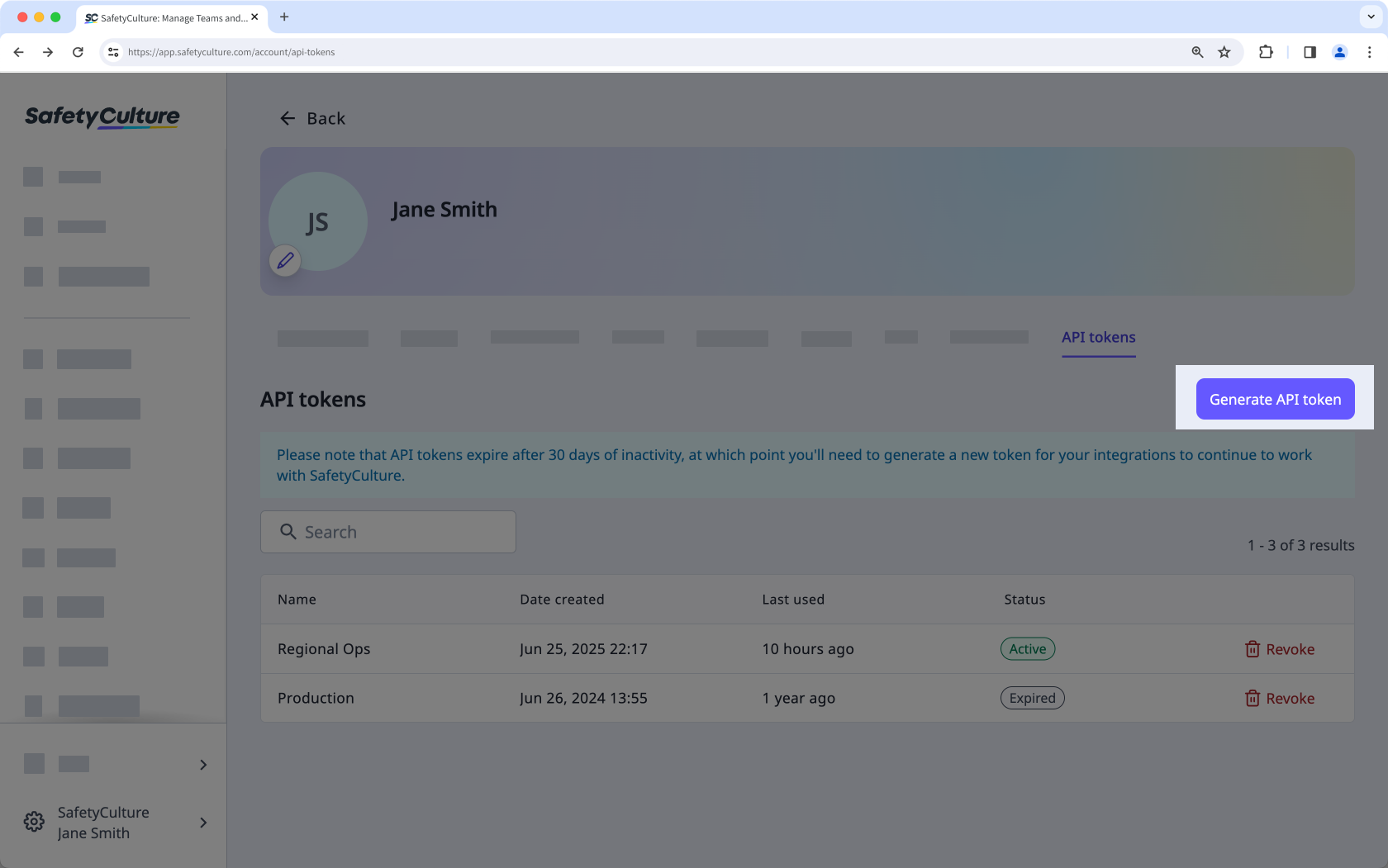
Haga clic en Generar token de API.
En la ventana emergente, introduzca un nombre para el token de API de usuario y la contraseña de su cuenta.
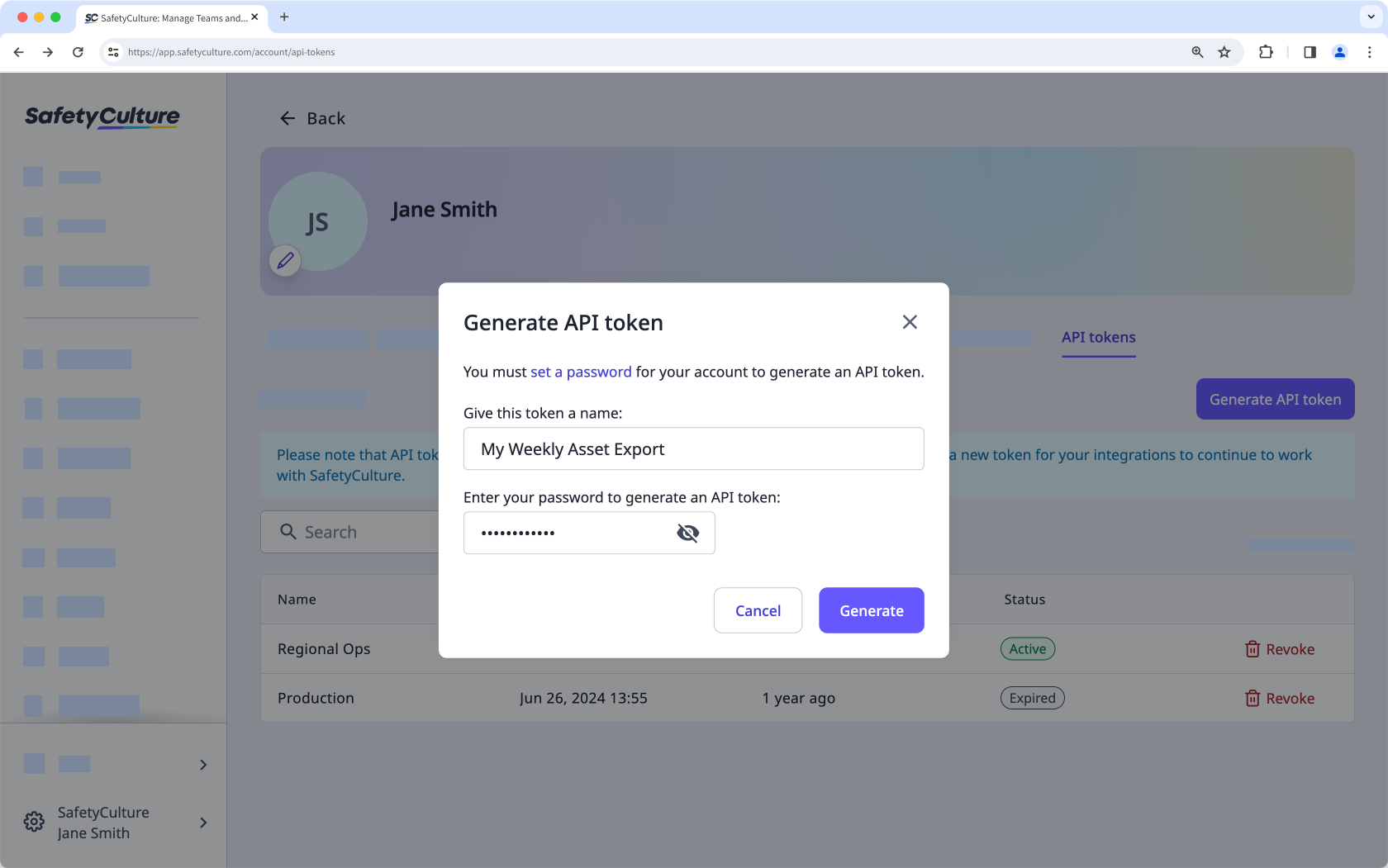
Haga clic en Generar.
Haga clic en el token de API de usuario para copiarlo. Guarde el token de forma segura antes de cerrar la ventana.
Revocar un token de API para usuario
Haga clic en su nombre de usuario en la esquina inferior izquierda de la página y seleccione Mi perfil.
Haga clic en Ajustes en la parte superior derecha de la página.
Seleccione Tokens de API en la parte superior derecha de la página.
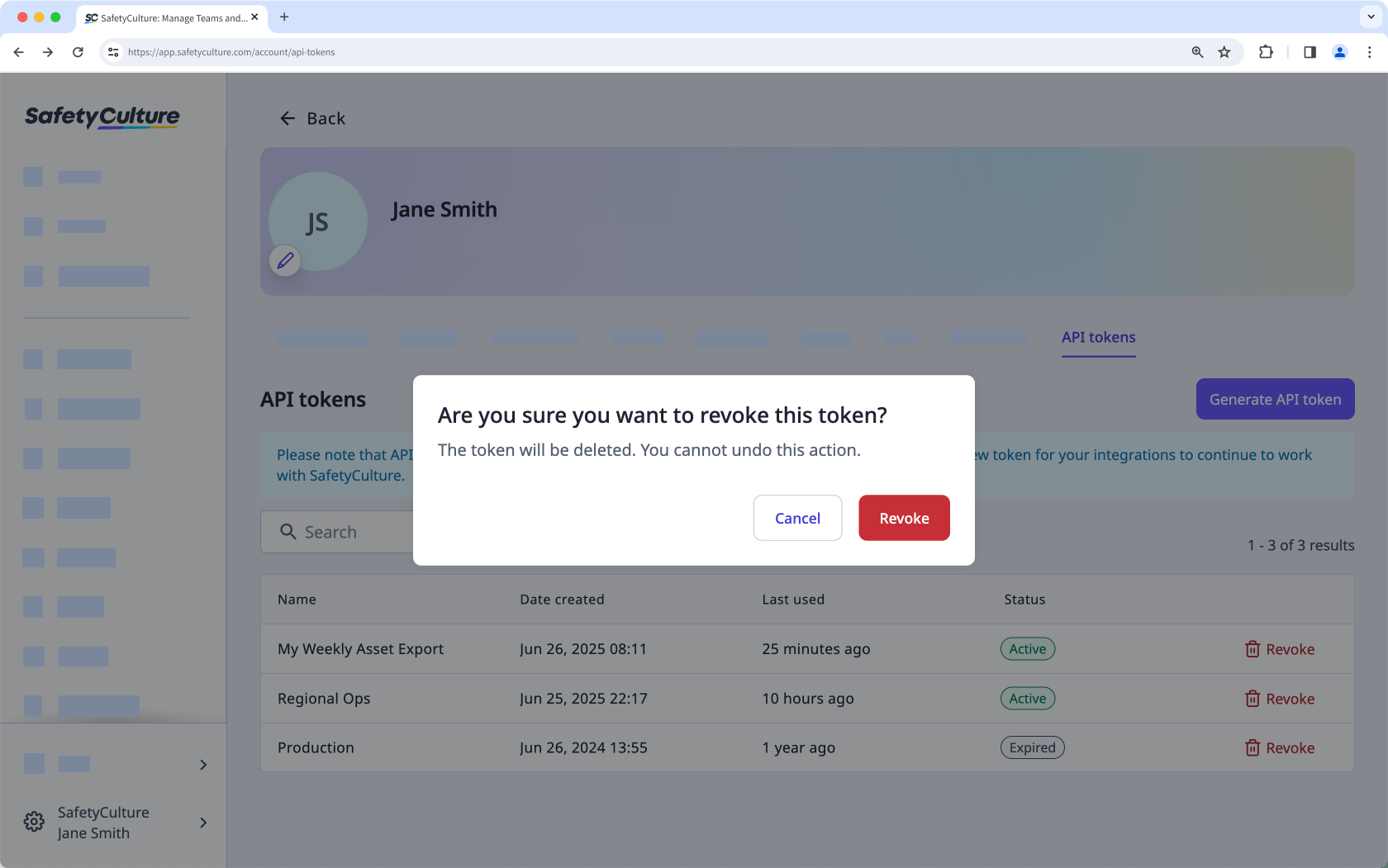
Haga clic en Revocar en el lado derecho del token.
En la ventana emergente, haga clic en Revocar.